




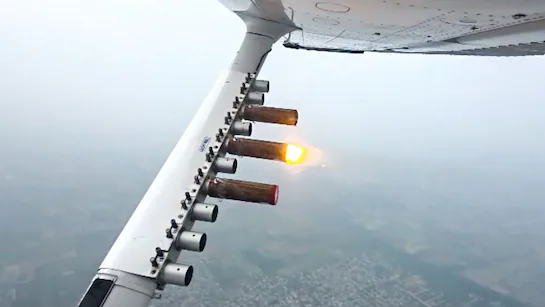
Delhi’s ambitious cloud seeding experiments to combat severe air pollution have failed to produce artificial rain, with scientists concluding that the capital’s winter atmosphere is fundamentally unsuitable for consistent weather modification. The setback has prompted experts to dismiss the costly technique as an ineffective solution to the city’s chronic smog crisis.
Expert Study Declares Winter Seeding Unviable
A comprehensive study released by IIT Delhi’s Centre for Atmospheric Sciences on October 31 concluded that cloud seeding “cannot be recommended as a primary or reliable strategy for Delhi’s winter air pollution management”. The report, analyzing climatological data from 2011-2021, found a “fundamental lack of sufficient moisture and saturation during the peak pollution months,” particularly in December and January when intervention is most needed.
“There is a fundamental lack of sufficient moisture and saturation during the peak pollution months (December-January), coinciding precisely when intervention is most needed,” the IIT Delhi study stated. The research identified only 92 viable days over the past decade when atmospheric conditions would have supported successful seeding.
Shahzad Gani, assistant professor at IIT Delhi’s Centre for Atmospheric Sciences and one of the study’s mentors, emphasized the meteorological constraints. “Delhi’s winter weather is usually too dry for effective cloud seeding,” Gani told the Economic Times. “In the winter season, the weather in Delhi is typically very dry, with very little moisture in the air. The only time it rains is when a western disturbance influences the plains.”
Even when successful, the study noted that artificial rain would provide “only a brief respite (typically one to three days) before pollution levels rebound” due to persistent emissions. The analysis also raised concerns about potential environmental impacts from seeding agents like silver iodide and the technique’s high operational costs.
Expensive Solution Offers Little Long-Term Relief
The financial burden of cloud seeding has drawn sharp criticism from environmental experts. Each sortie costs approximately Rs 60-64 lakh, with IIT Kanpur estimating that full-scale winter operations would require Rs 25-30 crore. The Delhi government has already allocated Rs 3.21 crore for up to 10 trials, but Environment Minister Manjinder Singh Sirsa acknowledged the approach is “not a permanent solution”.
“This is an SOS solution. When you have a crisis situation, very high pollution, it is one of the methods one can attempt in order to bring down pollution. It is not a permanent solution,” Agrawal said following the failed trials.
Critics argue that such substantial investments would be better directed toward addressing pollution sources. “Solutions like cloud seeding and smog towers are a distraction and a waste of resources,” Gani told The Indian Express. The study emphasized that “sustained emission reduction remains the most viable and necessary long-term solution” to Delhi’s air quality crisis.
The failed experiments underscore the limitations of technological fixes for Delhi’s pollution woes, which stem from vehicle emissions, industrial activities, construction dust, agricultural burning, and residential heating. With air quality indices frequently exceeding 300—well into “very poor” territory—experts stress that only comprehensive emission controls can provide lasting relief for the capital’s 20 million residents